Latest News

Aid Effectivness in Fragile States - Civil Society

April 20, 2012

World Bank Discusses Aid Effectiveness in Fragile States with Civil Society 

3P Human Security, the Alliance for Peacebuilding, and other members of an InterAction sub-working group on issues of aid effectiveness in conflict-affected and fragile states helped organize a panel discussion about the implementation of New Deal principles at the three-day Civil Society Policy Forum, part of the World Bank and IMF 2012 Spring Meetings. The meeting follows the global buzz generated when 35 donor and recipient countries (including the United States) signed the New Deal in Busan at the end of 2011.  The panel included government representatives from self-described "fragile states" (called the g7+), civil society representatives from the global South, and the coordinator of the North-South inter-governmental dialogue process (called the International Dialogue on Peacebuilding and Statebuilding which produced the New Deal).

The New Deal and the long-term global dialogue that made it become a reality is significant because it signals the broadest consensus ever reached between donor and recipient nations about how international aid to conflict-affected and fragile states must be done in a way that fosters more sustainable and inclusive development outcomes and inclusive state-society relations in parts of the world where cycles of war and poverty are most severe. 3P Human Security and peacebuilders around the world hope the principles of the New Deal will become a core pillar of whatever global development framework emerges after the Millennium Development Goals expire in 2015.

Liberia and Sierra Leone: New Publication from Conciliation Resources

March 27, 2012

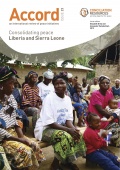
Consolidating Peace: Liberia and Sierra Leone

Almost ten years on from the official end of wars in Sierra Leone (2002) and Liberia (2003), attention is shifting from post-war peacebuilding to longer-term development. What headway has been made? What challenges lie ahead? And what lessons that can be learned?
This latest issue in the Accord series draws on experiences and perspectives from across societies in both countries to explore comparative lessons and examine progress. It builds on analysis and recommendations from previous Accord publications on Liberia (Issue 1: 1996) and Sierra Leone (Issue 9: 2000).

Alliance for Peacebuilding (AfP) along with 3P hosted London-based Conciliation Resources for a discussion titled Consolidating Peace: Liberia and Sierra Leone.  This event was held at Interaction on Tuesday March 27. 

Experts from Conciliation Resources included Ms. Janet Adama Mohammed, West Africa Program Director and Mr. David Newton, Director of Policy, Practice and Communications. Ms. Mohammed and Mr. Newton shared their analysis on the current state of both Sierra Leone and Liberia's transitions from war to peace, the key challenges that threaten these transitions, and initiatives, both local and international, which respond to these threats. The discussion focused on themes 
of formal/informal justice and reconciliation mechanisms, extending access and services beyond the cities, security sector reform (SSR), better governance of resource sectors, and creating opportunities for alienated youth. The Accord publication argues that an improved social contract between the state and society is central to continued peacebuilding progress in both countries.  

Click here for Conciliation Resources speaker profiles and for details about this event.  

Event: Somalia - Fresh Approaches to Peacebuilding

March 13, 2012

This months Conflict Prevention & Resolution Forum (CPRF) was organized by 3P and the Life & Peace Institute and took place on Tuesday, March 13 from 9:30 - 11:30am at Johns Hopkins SAIS.  The forum addressed the impact of current policies isolating blacklisted groups in Somalia and proposals for alternative perspectives that could encourage the design of an inclusive peace process in Somalia.

Scholar-practitioners from the Life and Peace Institute in Nairobi and the University of Notre Dame's Kroc Institute for International Peace Studies discussed a recent report: “Somalia: Creating Space for Fresh Approaches to Peacebuilding” that illustrates why the dominant strategy of isolating proscribed terrorist groups like al-Shabaab has a counter-productive effect on reducing violent extremism and building lasting stability in Somalia.

An afternoon roundtable discussion echoed the talking points of the morning forum.  Kay Guinane of Charity and Security Nework (CSN) joined the group in the afternoon to provide an update on proposals in the works for possible licensing mechanisms for track II peacebuiding and development.
 

Click here for speaker bio's and a brief background on Somalia.
Laura Weis, Kroc Institute; Shamsia W. Ramadhan, Life&Peace Institute (LPI);  Kristen Wall, Kroc Institute; John Filson, 3P Human Security; and Michele Cesari, LPI
     LPI and Kroc speakers participate in a rountable discussion on Somalia and the options for legalizing peacebuilding and development
Kay Guinane, Charity and Security Network and Michele Cesari, Resident Representative for the Life & Peace Institute
(L to R): Shamsia W. Ramadhan, Programmes and Communications Advisor, Life & Peace Institute; Laura Weis, Ph.D candidate, Kroc Institute/Notre Dame and David Cortright, Director of Policy Studies, Kroc Institute for International Peace Studies, University of Notre Dame

Kony 2012 & the Failed Fantasy of Fire Power

March12, 2012

Kony 2012 and the Failed Fantasy of Fire Power in Libya, Syria, Uganda...
In her most recent Huffington Post article, Lisa provides a look at how the West can work towards ending civilian suffering in Syria, Uganda, and elsewhere and why it is important to so without supporting a military intervention.
"The fantasy of firepower rests on a faulty assumption that 'evil' resides in a group of people that need to be killed in order to restore peace. A realist understands the civil wars in Libya, Syria and Uganda are far more complex than killing some 'bad guys.' Like pouring toxic chemicals into an oil spill, the solution of pouring weapons into a civil war just doubles the agony for civilians and prolongs instability."
To see the full Huffington Post article, click here.

Saferworld: China & Conflict-Affected States

March 7, 2012

On Tuesday March 6, 3P hosted Robert Parker and Larry Attree from Saferworld, along with Chin-Hao Huang from the University of Southern California and the Stockholm International Peace Research Institute (SIPRI).

Click here for a the event announcement

(L to R): Amanda Jantzi-Robinson, 3P Program Assistant; Rob Parker, Saferworld;
Larry Attree, Saferworld, John Filson, 3P Program Manager

Roundtable Discussion
Mr. Attree, Mr. Parker and Mr. Huang presented during a roundtable discussion at the Woodrow Wilson International Center for Scholars, discussing the implications for peace and stability of China's increasing engagement in conflict-affected states.  This discussion was moderated by 3P Director Lisa Schirch and hosted by the Wilson Center's Steve McDonald, Consulting Director of the Africa Program and the Project on Leadership and Building State Capacity.

Click on the pictures to the left to view the brief or report by Saferworld

Mr. Attree and Mr. Parker presented a report completed by Saferworld which is based upon research completed in four conflict-affected states: Sri Lanka, Nepal, Sudan and South Sudan.  Mr. Huang presented on his area of expertise: Chinese foreign and security policy, conventional arms control, peacekeeping operations and multilateral security institutions with regards China, Asia and Africa. 

In all four countries described in the Saferworld report, China has significantly increased its engagement in the last five years; it is now a major investor and has significant influence over reconstruction and development in these regions.  China itself is going through a period of policy development and adaptation as it engages more on issues of peace and conflict. China's new-found influence and the and the responsibilities that come with it provides a strategic opportunity for the West to engage with China.

 Public Panel Discussion
The afternoon event was hosted by 3P Human Security, Alliance for Peacebuilding and SAIS.  Mr. Attree, Mr. Parker, Mr. Huang were joined by a  respondent from USAID's Office of Conflict Management & Mitigation, Joseph Hewitt.  Lisa Schirch, Director of 3P moderated this event.

Panel presentation at SAIS on China and conflict-affected states
(L to R): Lisa Schirch, Director 3P; Rob Parker, Saferworld; Larry Attree, Saferworld;
Chin-Hao Huang, USC & SIPRI; Joseph Hewitt, USAID


Mr. Attree and Mr. Parker presented Saferworld research (see reports above) highlighting the implications for peace and stability of China's growing diplomatic, military, economic and aid engagement in conflict-affected states.  Mr Huang discussed his expertise on Chinese foreign and security policy and Mr. Hewitt offered his comments on what it means for the U.S approach in conflict-affected states and with China.


Qur’an burnings indicate need for mission overhaul

February 28, 2012

Qur’an Burnings Indicate Need for Mission Overhaul
Click here to read a Common Ground News Source article written  by Lisa Schirch and Karim Merchant regarding news of US troops burning copies of the Qur'an in Afghanistan.  This current crisis signals the need for more significant changes to the international forces' mission, as well as the preparation that members of the military receive. Such change must go beyond the current plans for a US drawdown.

Event: Congressional Briefing - Afghan Civil Society

Afghan Civil Society Perspectives: Congressional Briefing
Wednesday February 29, 2012 2pm - 4 pm
B-338 Rayburn – House Office Building

Rep. James McGovern and Rep. John Garamendi for
Afghan Civil Society Perspectives with Afghan-made documentary short films, a live video conference with Afghans and expert testimony and roundtable discussion with Michael Sheridan, Director and Founder of Community Supported Film; Peter Lems, Program Director for Afghanistan, Iraq, and Iran at American Friends Service Committee and Lisa Schirch, Director of 3P Human Security. 

Please join us at today, Wednesday February 29 at 2pm for an open Congressional Briefing about Afghan Civil Society perspectives on future stability and humanitarian concerns in Afghanistan. The event will feature a live video conference with Afghan NGO directors and filmmakers, a screening of a selection of the Afghan–made documentary shorts The Fruit of Our Labor, and a roundtable discussion with CommunitySupported Film, 3P Human Security, and the American Friends Service Committee (AFSC)

The briefing coincides with the DC opening of AFSC’s Windows and Mirrors Afghan mural exhibit organized with religious members from the Faith Roundtable on Afghanistan.

The Fruit of Our Labor films allow viewers to witness reality through Afghan eyes, offering a deeper understanding of Afghanistan that is crucial for mapping a peaceful and stable path forward and avoiding another humanitarian crisis as US and NATO troops withdraw. The films are a collection of documentary shorts made by Afghans in a training provided by Community Supported Film in Kabul. The films convey the realities and challenges of daily life in Afghanistan and also highlight Afghan-led development initiatives. The Fruit of Our Labor identifies critical areas that need sustained technical and financial support from US and international organizations – such as maternal healthcare, and access to clean water, education, and employment.


Presenter Lisa Schirch will discuss her study:

“Designing a Comprehensive Peace Process for Afghanistan,” which provides evidence of the importance of including Afghan Civil Society in building a stable and peaceful Afghanistan.

Event: Implementation and Procurement Reform

February 21, 2012

As part of the USAID Forward reform agenda, USAID is changing its business processes - seeking to contract with and provide grants to more and varied local partners.

3P attended a presentation on February 21, hosted by InterAction, an alliance of U.S.-based NGO organizations focused on the world’s most poor and vulnerable populations.  More than fifty organizations were represented at the event.  USAID’s General Counsel Lisa Gomer discussed the agency’s recent developments in implementation and procurement reform (IPR).  

Most notably, USAID’s IPR initiative includes revisions to Regulation 22 CFR 228 Source and Nationality Policy which establishes USAID’s source and nationality procurement requirements. The new regulation, published on January 10, 2012, is intended to both simplify and streamline USAID’s procurements by::
  1. Authorizing procurements in the recipient and other developing countries along with the United States, as Congress directed in the Foreign Assistance Act, via a new default Geographic Code of 937.
  2. Eliminating the requirement to determine the “origin” of a commodity -- a difficult task in today’s globalized economy -- and simplifying and clarifying source and nationality requirements to restrict procurements from foreign government controlled vendors.
  3. Streamlining procedures, including those necessary to obtain a waiver in the event goods or services are needed from any other country or region. 
Examples of how the objectives of IPR are being implemented can be viewed here in a September 2011 USAID newsletter.

A Comprehensive Peace Process in Afghanistan

February 20, 2012 

Lisa Schirch presented her research on the design of a comprehensive peace process in Afghanistan with researchers Bart Klem and Jonathan Goodhand on 20 February at London's Chatham House. The Chatham House Presentation was titled "Ptifalls of Peace: Negotiating Settlements in Sri Lanka and Afghanistan", London.  
Click here for a link to the event.

 While in London, Lisa also participated in a panel at the the London School of Economics. This event was titled "Designing a Comprehensive Peace Process in Afghanistan" and focused on the importance of including Afghan civil society in a comprehensive peace process. Lisa presented alongside the US State Department adviser to the Special Representative for Afghanistan and Pakistan Rina Amiri, Conciliation Resources Director Andy Carl and Open Society Institute staff Fatima Ayub in a discussion on the importance of including Afghan civil society in a comprehensive peace process.  

Iraq delegation in Washington

February 3 - 10, 2012

3P hosted a delegation of four Iraqi civil society leaders in Washington to speak with various offices across the government, policy organizations and NGOs, as well as faith communities and other public audiences about what is happening in Iraq now following the withdrawal of US troops.


To read Delegate Profiles, click here
To read a Policy Brief on the role of Iraqi civil society in the post-US era, click here.

Institute For Policy Studies, meeting with Peace Action Group
Widespread insecurity, fear, lack of basic services and jobs continue to weigh heavily on Iraqi families. Meanwhile, Iraq struggles to establish a government that is legitimate, capable, and accountable to the needs of Iraqi people.With the US military presence ended, it is up to Iraqis themselves to ensure the
Open Society Foundation luncheon
government does not return to authoritarian rule. After losing so many Iraqi and American lives over the last 9 years, it is critical for the US to articulate clear and unequivocal support for genuine, democratic process in Iraq that ensures accountable governance, protection of human rights, and a robust civil society sector that allows citizens to directly shape the affairs that affect their lives.

Mennonite Central Committee conducted a survey of over 100 Iraqi NGO leaders that identifies the most pressing priorities of Iraqi civil society.
Click here to read the summary.
Iraqi Delegates with Rachelle Lyndaker Schlabach, Director of Mennonite Central Committee Washington Office and John Filson, Program Manager of 3P Human Security.

DC-based peacebuilding and human rights organizations met for a conversation about Iraq's civil society sector and the key factors needed for lasting development and human security.

Camp Atterbury: Afghan Governance & Civil Society

February 2, 2012

Provincial Reconstruction Teams, Camp Atterbury, Indiana
Lisa traveled to Camp Atterbury, a training base and simulated Afghan village in southern Indiana where she was invited to give a keynote dinner talk on Afghan governance and civil society to a group of senior commanders going to Afghanistan.  This presentation focused on the importance of humanitarian space for the safety and contributions of Afghan civil society and international NGOs, highlighting the contributions civil society makes to governance and development throughout the country. 

Formal & Informal Governance in Afghanistan

January 23, 2011

Linking Formal and Informal Governance in Afghanistan
Lisa Schirch presented on a panel at the Center for Naval Analysis, Arlington, Virginia, examining cultural approaches to governance and stabilization along with former Deputy Assistant Secretary of Defense Rosa Brooks.  3P's presentation on "Linking Formal and Informal Governance in Afghanistan" was  co-written with Karim Merchant and has been submitted in chapter form for publication in a forthcoming book.

Event: Civ-Mil Space & Humanitarian Response

January 19, 2012

Crowded Civil-Military Space: Evolution of Humanitarian Crises and Response
3P and InterAction hosted a roundtable discussion with Feinstein International Center of Tufts University to discuss their in-depth research and resulting policy implication for the evolving field of humanitarian response and the link between humanitarian, development and security goals and actors. 

This roundtable discussion featured Peter Walker, Director and Professor of Nutrition & Human Security and Antonio Donini, Senior Research and Instructor, both from the Feinstein International Center.  Walker and Donini presented Feinstein’s research on three broad areas: 
1) Working with Complexity
2) Aid and Military Sharing Space 
3) Working with the State. 

Presentations were drawn from their respective research reports on Professionalizing the Humanitarian Sector (2010) and Winning Hearts and Minds: Examining the Relationship between Aid and Security in Afghanistan (Jan 2012) along with their forthcoming book on the instrumentalization of aid.

Click here to see the PowerPoint presentation Working with the State.
Click here to see the PowerPoint presentation Perception of Security and Aid.

1) Working with Complexity: How is the humanitarian enterprise handling the complexity it faces, with more frequent and more types of crises, competition between and amongst local and international actors, and differences between state vs non-state humanitarian approaches?

2) Aid and Military Sharing Space: What does research suggest about the use of humanitarian and development projects in the service of counterinsurgency to bring or maintain security in strategically important environments, and by "winning hearts and minds" undermine support for radical, insurgent, or terrorist groups?

3) Working with the StateWith sovereignty and nationalism increasingly impacting on the practice of humanitarian action, how are tensions between “state avoiding” and the “state embracing” agendas affecting humanitarianism?
Peter Walker and Antonio Donini from Tufts University Feinstein International Center talk with Worldvision's Randy Tift in front of InterAction's memorial to Fallen Colleagues whose lives were cut short while providing relief and development services around the world."


Civil Society: Conflict Prevention and Response

 September 2011- January 2012

Integrated Education and Training Working Group on Conflict Prevention and Response
Lisa Schirch and Alliance for Peacebuilding (AfP) President Melanie Greenberg represented civil society expertise in conflict prevention and peacebuilding at a U.S. government inter-agency working group.  They addressed the need for greater coordination of training and education opportunities for U.S. government personnel to learn basic and advanced skills in conflict prevention and response.  The working group developed an extensive set of recommendations that will be managed by an ongoing group of high-level government leaders.

Event: Aid Effectiveness in Fragile States

Dec 15, 2011 

Post-Busan Debrief on Aid Effectivess in Conflict-Affected Regions
U.S. government and civil society representatives who participated in the Fourth High-Level Forum on Aid Effectiveness in Busan, Republic of Korea Nov 29 - Dec 1 offered analysis of the major outcomes of the historic forum and what it means for US-sponsored aid mechanisms and the larger discussion of development effectiveness, especially in conflict-affected and fragile states.
 3P initiated collaboration with the Alliance forPeacebuilding, the Woodrow Wilson Center, USAID, InterAction, and CDA Collaborative Learning Projects to host a post-Busan de-briefing event on Dec 15th. 

Click here for the event agenda.
Click here for a recording of the event.

From left: South African Ambassador to the U.S. Ibrahim Rasool,3P Program Manager John Filson, and World Vision Senior Policy Advisor Randy Tift
 Leaders of the official USG delegation to Busan and several CSO participants in Busan provided analysis of the historic forum and its implications for the way USAID and other donors approach international development cooperation. The second of two panels focused on the effectiveness questions in conflict-affected and fragile states, such as G7+ countries in Asia and Sub-Saharan Africa where the lack of effective development is a major obstacle to human security. Most of the 19 G7+ countries have not yet reached a single Millennium Development Goal, and it was the sense of both U.S. officials and CSO representatives that the US must do more to foster genuine improvement.

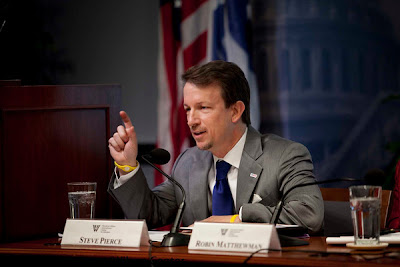
Steve Pierce, Senior Advisor, Office of Donor Engagement,
 Bureau for Policy, Planning  and Learning, USAID